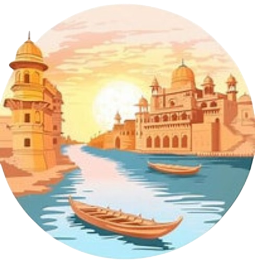
Congratulations on reaching this stage of the quiz! The
Ganges River, known as the Ganga in India, is not only the
country's longest river but also holds profound religious
significance for Hindus. Originating from the western
Himalayas, it traverses India and Bangladesh, covering a
distance of approximately 2,525 kilometers before
emptying into the Bay of Bengal. For centuries, the Ganges
has been a symbol of faith and a source of livelihood for
millions.
Historically, the Ganges has played a pivotal role in shaping
the economic, social, and religious fabric of the region. It
has served as a vital transportation route since ancient
times, facilitating trade and cultural exchanges. The fertile
plains of the Ganges basin are among the most intensively
farmed areas, producing crops such as rice, wheat, and
sugarcane. Additionally, the river's waters support various
industries and provide drinking water to countless
communities.
Religiously, the Ganges is revered as a goddess and is
central to numerous Hindu rituals and beliefs. Pilgrims
from all over the world visit its banks to bathe in its waters,
seeking purification from sins and the attainment of
salvation. Cities like Varanasi and Haridwar, situated along
the Ganges, are considered some of the holiest sites in
Hinduism. The river also hosts the Kumbh Mela, the world's
largest religious gathering, attracting millions of devotees
who come to perform ritualistic baths and participate in
spiritual ceremonies.