Book two
The Life of Joe
Early Days
Dear Reader this book is for you to construct.
the story must be relevant to what happens in book three
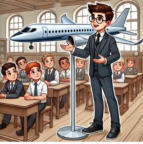
Remember where book One left off ? - Start composing
your book from the end of chapter 17’ in book 0ne.
Chapter 17: Computing, Chips, and the Digital Dream
By the time Joe was imagining computers with hard drives
and memory, the earliest hard drives were already being
developed, although they were incredibly large and held just
a few megabytes. But Joe’s vision extended far beyond. He
could see computers in people’s homes, guiding rockets,
flying planes, running city lights, and changing how people
learned, worked, and even made art.
Your book starts from here
.
.Joe is now in his teens lets say 19 years old,
your book takes him up to his thirties.
We
know
one
thing
for
sure
.Joe
got
Married
and
had
two
children.
He
became
extremely
rich.
He
became
well
known
tv
presenter
with
his
own
science
show.
He
loved
fast
cars
and
aircraft
and
travelled
extensively.
His
wife
passed
away
and
he
emigrated
to
Australia
and
bought
a
great
house
overlooking
the
sea
on
the
Sunshine
coast.
He
loves
music
and
is
a
brilliant
pianist --
Use your creative imagination to construct your book, The
following list shows significant happenings over the period
you are covering, but do research more for yourselves.
Whats Going on in the world at this time?
We have given you a list of events for the relevant years
“see below”
1959 First Mooncraft: The Soviet Union's Luna 1 became the first spacecraft
to escape Earth’s gravity.
Xerox 914 Copier Released: The first practical photocopier brought
affordable document duplication to offices worldwide.
Princess Margaret's Engagement:
On February 26, 1959, Princess Margaret, Queen Elizabeth II's sister,
announced her engagement to Antony Armstrong-Jones (later known as
Lord Snowdon). Their marriage in 1960 was a significant event for the Royal
Family, as it marked the first time in modern British history that a royal
married someone outside the aristocracy.
The Worst Cold Winter in Europe (1959-1960):
The winter of 1959 was extremely cold across much of Europe, leading to
major transport disruptions, food shortages, and deaths due to freezing
temperatures. In the UK, harsh winter weather contributed to widespread
power outages and accidents.
A Disney animated classic, Sleeping Beauty was released in 1959. It features
the iconic character of Princess Aurora and is one of Disney's most famous
animated films, known for its lush animation and Maleficent, one of
Disney's greatest villains.
The Development of Widescreen Formats:
The late 1950s marked the rise of widescreen formats in response to the
increasing popularity of television. In 1959, the CinemaScope process
(which had been introduced in 1953) continued to gain popularity, with
films like Sleeping Beauty and Some Like It Hot making use of it.
CinemaScope used anamorphic lenses to produce a wider image on the
screen, providing a more cinematic feel that was different from the boxy
aspect ratio of TV sets.
1960 First Laser Built: Theodore Maiman created the first working laser,
paving the way for applications in medicine, communications, and
consumer electronics
.
Echo 1 Satellite: NASA launched this passive communications satellite,
enabling transcontinental and transatlantic phone calls.
1961 First Human in Space: Yuri Gagarin of the USSR orbited Earth aboard
Vostok.
Cordless Tools Introduced: Black & Decker launched the first cordless power
drill, improving home and professional maintenance tasks.
First Commercial Communications Satellite: Telstar began transmitting TV
signals and phone calls across continents
1962 Boeing 727 First Flight: Designed for short to medium-haul routes, it
introduced features like a rear-engine design and advanced aerodynamics.
LED (Light Emitting Diode) Invented: Nick Holonyak developed the first
practical LED, laying the groundwork for modern lighting and displays.
Audio Cassette Introduced:
Philips launched the compact cassette, simplifying music and voice
recording.
1963 Learjet 23 Introduced: Pioneered business jet travel,
offering faster and more exclusive transportation for corporate clients.
Push-Button Telephone: Replaced rotary dials, speeding up dialing and
simplifying communication.
1964 BAC One-Eleven Enters Service: A British short-haul jet, it became
popular with smaller airlines and introduced jet travel to regional routes.
IBM System/360 Announced: The first general-purpose mainframe
computer, influencing the growth of businesses and government data
systems.
Plasma Display Panel: Developed by Donald Bitzer, it became the precursor
to modern flat-screen TVs.
1965 The first automatic landing (autoland) was successfully
demonstrated on June 10, 1965, by a British Aircraft Corporation (BAC) One-
Eleven aircraft. This event marked a significant milestone in aviation
history.
Boeing 737 Development Began: Designed as a short-haul jetliner, it would
become one of the best-selling aircraft in history.
Touch-Tone Phones Launched: Introduced more efficient dialing and future
integrations with automated services.
Moore's Law Formulated: Gordon Moore predicted the exponential growth
of transistors in ICs, driving advancements in technology
1966 First Flight of Concorde Prototypes: A joint Anglo-French effort to
develop a supersonic passenger jet capable of twice the speed of sound.
Boeing 737 First Flight: Revolutionised short-to-medium-range air travel
with its simplicity and efficiency.
ATM Concept Unveiled: James Goodfellow patented the first automatic
teller machine (ATM), making banking more convenient.
Soft Contact Lenses: Introduced for improved comfort and usability,
revolutionising vision correction.
Luna 9: The Soviet spacecraft became the first to make a soft landing on
the Moon
1967 Lockheed SR-71 Blackbird Enters Service: A reconnaissance aircraft
capable of Mach 3 speeds and advanced stealth capabilities.
Pocket Calculator Prototype: Texas Instruments developed a handheld
device for mathematical calculations, eventually replacing slide rules.
First Automated Teller Machine (ATM) Installed: Barclays Bank in London
deployed the first functional ATM.
First Heart Transplant: Performed by Dr. Christiaan Barnard in South Africa
1968 Boeing 747 Unveiled: The world’s first wide-body "jumbo jet,"
revolutionising international air travel with its capacity for over 400
passengers.
Harrier Jump Jet (Hawker Siddeley Harrier): The first operational
vertical/short takeoff and landing (V/STOL) aircraft, useful for military
operations.
First Computer Mouse: Invented by Douglas Engelbart, improving user
interaction with computers.
Videocassette Recorder (VCR): Sony introduced the first VCR, allowing TV
shows to be recorded and played back at home.
1969, Concorde's First Flight: Marked a new era of supersonic commercial
travel, reducing transatlantic flight times significantly
.
Boeing 747 Maiden Flight: Designed to cater to the growing demand for
mass air travel with unmatched passenger capacity
ARPANET Established: Precursor to the Internet, enabling remote
communication between computers.
First Home Microwave Ovens: Hitachi and Amana introduced smaller,
affordable microwaves for households.
Concorde's First Flight: The supersonic passenger jet redefined air travel
speed.
Moon Landing: Apollo 11 landed Neil Armstrong and Buzz Aldrin on the
Moon.
Woodstock Festival: Iconic music festival celebrated peace and music.
Internet Birth: ARPANET, the precursor to the Internet, sent its first
message.
1968: Development of the Anti-Lock Braking System (ABS)
First introduced by Mercedes-Benz and later refined, ABS improved safety
by preventing wheels from locking during braking, especially in slippery
conditions.
Germany and Japan began actively testing maglev technology, which would
lead to significant developments in the 1970s.
1970 Douglas DC-10 First Flight: A wide-body jet aimed at bridging long-haul
routes with a smaller capacity than the 747.
Floppy Disk Invented: IBM's 8-inch floppy allowed easy data storage and
transfer.
Digital Wristwatch: Hamilton released the Pulsar, the first digital watch,
marking a shift in personal technology.
First Fibre Optic Communication: Bell Labs demonstrated the potential of
fibre optics for high-speed communication

Voice to text notebook
is a handy tool to assist you here is the link
